The Rind Is Part of the Story, Not a Full Biography
Washed, bloomy and natural rinds offer clues about how a cheese was made and cared for. They can guide what you do next, but appearance alone cannot settle the question of quality or condition.
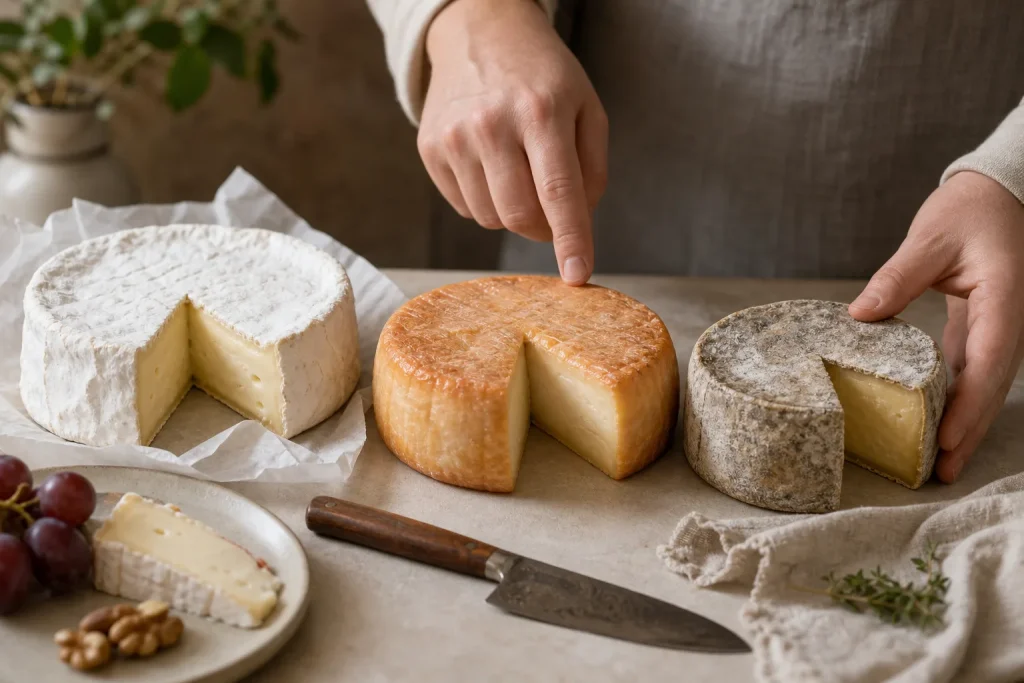
At a cheese counter, a pale wheel wears a soft white coat while its neighbour has an orange, slightly tacky surface. A third looks almost bare, its rind a dry brown-grey. These differences are useful clues: they can point towards distinct ways of making and handling cheese. But a rind is more like a book’s cover than its full contents. It suggests a story; it cannot tell the whole one.
The practical question is not simply, “What kind of rind is this?” It is, “What can I reasonably infer, and what should I check before choosing or serving it?” The answer depends on the cheese’s style, the way it has been kept and the decision in front of you.
If you see a soft white coat, what fits?
A soft, white, velvety or faintly downy rind often belongs to a bloomy-rind cheese. A cheesemaker adds or encourages surface moulds, commonly from the Penicillium family, and the rind develops as the cheese ripens. Brie and Camembert are familiar examples, though the appearance alone cannot identify the exact method or the milk beneath it.
Choose this style if you want a cheese whose texture and flavour can change noticeably from the edge towards the centre. As ripening progresses, the paste beneath the rind may soften and become more yielding. The coat is not a decorative shell added after the work is done; it is part of the cheese’s ripening environment.
For serving, follow the seller’s or maker’s guidance and give the cheese time to lose some of its refrigerator chill if appropriate for its style. A bloomy surface that is evenly soft and consistent with the cheese’s description is a different matter from unexpected wetness, damaged wrapping or an aroma that seems plainly unpleasant. If you are unsure, ask the cheesemonger rather than trying to diagnose the cheese from colour alone.
If the surface is orange or tacky, what fits?
An orange, coppery or reddish surface can be associated with a washed rind. During ageing, a cheesemaker or affineur may regularly moisten the rind with brine or another suitable liquid, sometimes while turning the cheese. This encourages particular surface conditions and can help shape the rind’s colour, texture and aroma. The treatment varies, so “washed rind” does not describe one fixed recipe.
This style may suit you if you enjoy a pronounced, savoury aroma and a paste that can be supple or creamy. The smell can be more assertive than the flavour, and a strong odour by itself does not tell you that a cheese is spoiled. On the other hand, a striking smell is not a reason to ignore signs that conflict with the cheese’s usual condition or the advice on its packaging.
If you are buying it for a shared table, consider the setting as well as your own preference. A washed-rind cheese may be a welcome centrepiece for people who like robust aromas, but less comfortable in a small, enclosed room or beside delicate foods. Ask for a small piece to taste when that is available, and ask how the cheese is meant to be stored once cut.
If the rind looks dry, rustic or uneven, what fits?
A natural rind can form as the cheese loses moisture and its surface changes during ageing, without the same deliberate mould coating associated with a bloomy rind or the repeated washing associated with a washed one. Some natural rinds are brushed, turned or otherwise cared for. Others develop a more irregular surface. “Natural” therefore does not mean untouched, nor does it mean every visible mark is welcome.
This may fit you if you are choosing a firm, aged cheese whose rind is part of a drier, more structured outer layer. It may be edible in some styles and unpleasantly tough in others; the appearance does not settle that choice. Ask the cheesemonger whether to eat it, trim it or use it in cooking. If the cheese is sold with clear handling advice, let that advice take precedence over a general rule.
A rustic surface can reflect a particular ageing environment or routine, but it cannot certify that the cheese was made in a specific region, from a particular animal’s milk or by a particular tradition. Those claims need information from the producer or seller. A rough rind is not, on its own, evidence of either careful craft or poor care.
If you are judging ripeness, what should you check?
Use the rind as one clue among several, not as a ripeness gauge by itself. Look at the cheese’s stated style and any ripening advice, then consider the paste, aroma and feel where those can be assessed without damaging the cheese. A bloomy rind may accompany a softening paste, but the same pale coat can sit over cheese at different stages of ripening. Colour and fuzz do not provide a reliable timetable.
Imagine you are choosing a bloomy-rind cheese for supper and the centre looks firm through the cut face. You had hoped for a very soft texture, so you ask the cheesemonger whether this piece is ready for that preference or whether a firmer serving is more typical. The useful result is not a verdict drawn from the rind alone, but a choice matched to the texture you want and the seller’s knowledge of that cheese.
If you need to decide what to do with the rind, what fits?
For a tasting board, leave the rind on where it is customarily served and let guests decide after a first bite. The rind can contribute a different texture and flavour from the paste, but preference varies. If you are serving people unfamiliar with the cheese, a quiet note about the rind’s style is more helpful than presenting every rind as edible or every rind as something to discard.
For cooking, use the cheesemaker’s or seller’s advice. A clean, suitable rind may add savoury depth to a pot of soup or beans, while a hard or strongly flavoured one may not suit the dish. Do not assume that a rind is useful in cooking just because it is technically part of the cheese; the result depends on its material and the flavour you want.
For a wrapped piece at home, check the label and any storage instructions before changing how it is kept. If the package is damaged, the cheese has an unexpected appearance or smell, or you cannot tell whether a surface change belongs to its style, avoid relying on a visual guess. Contact the seller or maker for product-specific advice, and follow the food-safety guidance issued by the relevant public-health authority in your country. If you are serving someone who may be more vulnerable to foodborne illness, consult that authority or a qualified health professional about suitable choices.
Keep the broad distinctions in mind: a soft white coat often points towards a bloomy rind; an orange, tacky surface may suggest washing; and a drier, less uniform exterior may be natural. Each tells you something about the cheese’s surface and care. None can, by itself, establish its origin, exact recipe, ripeness, quality or safety. When the decision matters, the label and a direct question to the person who knows the cheese are better guides than appearance alone.
Along the same table

A Shared Bottle, Several Ways to Serve It
At one imagined supper, a host keeps wine service flexible: guests can choose when to pour,…
From Curd to Texture: The Choices Behind a Cheese
A cheese’s moisture and texture begin to take shape before the curds reach the mould. Learn…