From Curd to Texture: The Choices Behind a Cheese
A cheese’s moisture and texture begin to take shape before the curds reach the mould. Learn how cutting, stirring and draining decisions can help explain a batch that feels too wet, too dry or uneven.
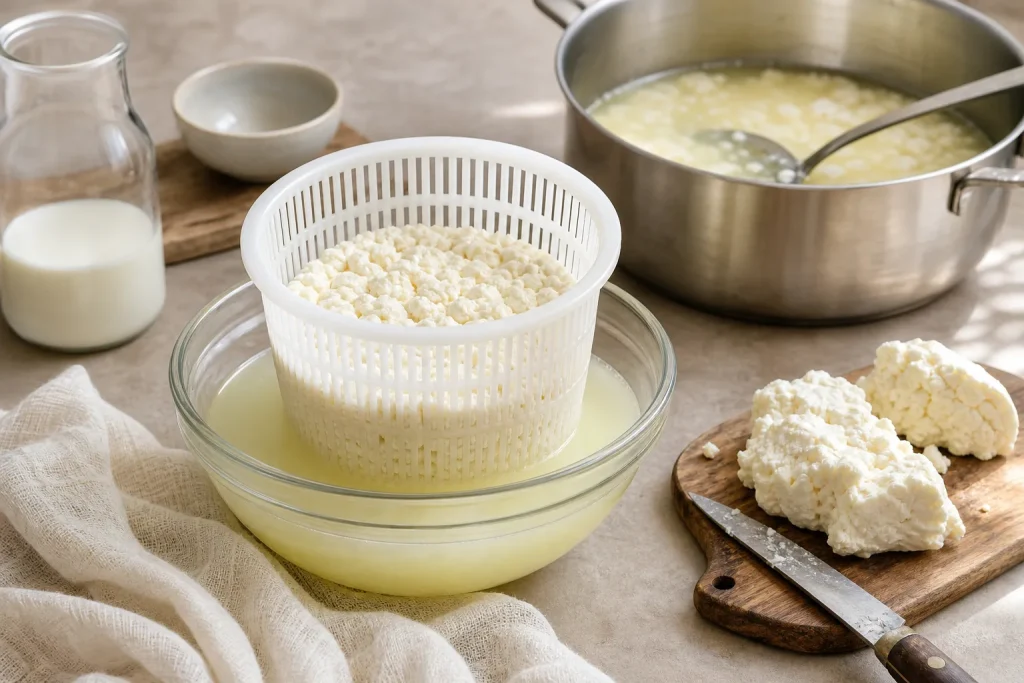
A fresh cheese sits in its mould while whey slips into the bowl beneath it. The curds look simple enough, but their size, firmness and time in the whey have already shaped the batch. When the cheese turns out softer, drier or more uneven than expected, it helps to trace the handling choices rather than reach for a single universal remedy.
Curd behaviour depends on the cheese style, recipe, milk and make. A cue that is useful for one fresh cheese may be misleading for another, so use the recipe’s instructions as your frame of reference and treat visual checks as prompts to pause, not as fixed diagnoses.
What can make a curd seem too wet?
Curds that remain fragile or release whey slowly may reflect a cut that is too coarse for the intended style, a gel that was not ready to cut, or a process that calls for more time to firm. Those possibilities are not interchangeable: the recipe and the curd’s condition help determine which response makes sense.
Before cutting, compare the curd with the recipe’s description of a set gel. If a clean knife or curd cutter leaves a line that closes at once or tears the gel, pause rather than cutting the whole vat; if the cut stays distinct and whey begins to gather along it, proceed according to the recipe. Neither sign alone determines the finished texture.
If the curd is already cut, avoid vigorous stirring as a quick fix. Follow the recipe’s handling and draining directions, watching for whether the pieces remain intact or begin to break apart. For a later make, consider changing cut size only when the recipe’s style and the observed curd support that adjustment; finer pieces can shed moisture more readily, especially with forceful handling.
Imagine you are making a fresh cheese from a recipe that asks you to cut only after the gel holds a clean edge. You lift a small section with a clean knife, see it tear, and pause rather than cutting the vat; after waiting as the recipe directs, you check again. If the second cut holds its line, you continue; if it still tears, you follow the recipe’s guidance or seek advice from an experienced cheesemaker instead of guessing at a new timing.
Why might a cheese turn dry or crumbly?
A dry or crumbly result can follow from moisture leaving the curd more readily than the style calls for. A fine cut, sustained stirring, warm handling or a long drain may all contribute, but their effects vary with the recipe and the curd itself.
Trace the sequence rather than changing several things at once. Note whether the curds were cut finer than directed, stirred more forcefully, or left draining after they had become cohesive. Those observations can suggest where to look, but they do not establish a cause on their own.
For a subsequent batch, make one adjustment that fits the recipe. If the curds became firm during stirring, ask whether the recipe permits gentler or shorter stirring; if the drain continued beyond the point its instructions describe, follow that stopping cue next time. Avoid making a much larger cut as a countermeasure without considering the cheese style, since the centre of a piece may retain moisture while the outside changes.
Think of cut curd like diced fruit in a sieve: smaller pieces expose more surface to draining. The analogy has limits, because curd is a delicate gel whose behaviour also depends on the make, but it offers a plain reminder that cutting changes the material being handled.
How can texture vary from edge to centre?
A firmer outside and softer centre may be associated with differences in curd size, stirring or drainage. Larger pieces can retain moisture differently from small fragments, while a crowded vat may allow some curds to settle or clump. The finished texture alone cannot identify which of these occurred.
Before moulding, look for a wide spread in piece size. If larger sections remain, follow the recipe’s cutting instructions rather than chopping at random; if the pieces are already reasonably even, avoid extra cutting that could shred them. Stir gently enough to separate clumps only when the recipe calls for stirring.
At draining, observe whether whey collects unevenly around the curd. If one area remains pooled, check whether the mould or cloth is positioned as the recipe specifies; if the arrangement is correct, avoid pressing hard merely to level the surface. For a make that calls for gentle self-draining, excess pressure can change the curd’s structure.
Keep a short note of what you saw before moulding, such as “mostly small pieces, with a few larger sections”. That description is more useful than “about right” when you later consider whether uneven cutting or clumping might have played a part.
What if the curd breaks apart during draining?
Curds that fragment or smear may have been moved before they were ready, cut with a tool that dragged through the gel, or stirred more forcefully than the make allows. A weak set can also leave the curd less able to withstand handling. The right response depends on the style and the recipe, so avoid treating any single tactile cue as a rule for every cheese.
Before transferring curd, use the recipe’s stated signs of readiness. If it calls for a cohesive curd and yours is still visibly fragile, pause only as its directions allow; if the curd has reached the described condition, transfer it with the specified tool and method. A broad draining spoon can be gentler than tipping a vat, but it is not appropriate for every make.
If fragments are already in the whey, avoid squeezing or pressing them together unless the recipe specifically directs it. Let them drain by the method intended for that cheese, and consider whether the batch remains suitable for its planned use. Follow reliable cheesemaking and local food-safety guidance, especially for fresh cheese and milk handling; appearance and texture cannot establish food safety.
Which observation should guide the next adjustment?
When a batch misses its intended texture, resist changing cut size, stirring, temperature and draining all at once. Begin with the clearest observation, then choose an adjustment only if it fits the recipe and the style. Each item below pairs a visible sign with a decision and an alternative if that sign is absent.
- The curd tears at the first cut: if the recipe describes a firmer set, pause and follow its guidance before cutting further; if the curd holds a clean line, proceed as directed rather than waiting without a reason.
- Large pieces remain after cutting: if the recipe calls for smaller, even pieces, follow its cutting method to address them; if it specifies larger pieces, leave them intact rather than cutting finer by default.
- The curds become firm during stirring: if the recipe gives a stopping cue that has been reached, stop or drain as instructed; if the curds remain as described for continued stirring, follow that stage rather than stopping on firmness alone.
- Curd sizes vary noticeably: if the recipe calls for even pieces, use its cutting guidance on the remaining large sections; if the variation is expected for that style, avoid extra cutting that may break smaller curds.
- Whey pools unevenly around the mould: if the cloth or mould is out of position, correct the setup; if it matches the recipe, leave the curd undisturbed rather than pressing it to level the surface.
- Fragments smear during transfer: if the curd is still fragile and the recipe allows a pause, wait as directed before further handling; if the recipe calls for immediate transfer, follow its method and consult an experienced cheesemaker about recurring problems.
- The finished cheese is drier than intended: if notes point to prolonged stirring or draining, adjust only that stage when the recipe permits; if no such change is recorded, keep the process stable and seek advice before altering several variables.
These are prompts for decisions, not universal diagnoses. Milk, culture activity, acidity and intended style all affect curd behaviour. If the make repeatedly behaves unexpectedly, return to a reliable cheesemaking text or ask an experienced cheesemaker to review the recipe and process.
How can the next batch be easier to interpret?
Record what you saw and did: whether the cut held its line, how the curd moved under the spoon, what the recipe said about draining, and how the pieces looked before moulding. A note such as “curd tore at the first cut; waited as directed; second cut held” turns “too soft” into a sequence that can be considered.
Change one permitted decision at a time, then compare the next batch’s observations with the previous notes. If you alter the cut, for example, note whether the curds behaved differently during the recipe’s later stages; do not assume that one change explains every difference.
The mould is where earlier choices become visible, but it is not where texture begins. A careful note of the recipe, the curd’s condition and the handling used can help you distinguish a useful adjustment from a guess, while leaving room for the differences between cheese styles.
Along the same table

A Shared Bottle, Several Ways to Serve It
At one imagined supper, a host keeps wine service flexible: guests can choose when to pour,…

At the Market, Let the Basket Sketch the Region
A market basket can reveal how a place eats through seasonal produce, everyday staples and the…