At the Market, Let the Basket Sketch the Region
A market basket can reveal how a place eats through seasonal produce, everyday staples and the connections vendors explain—without asking a few stalls to speak for an entire region.
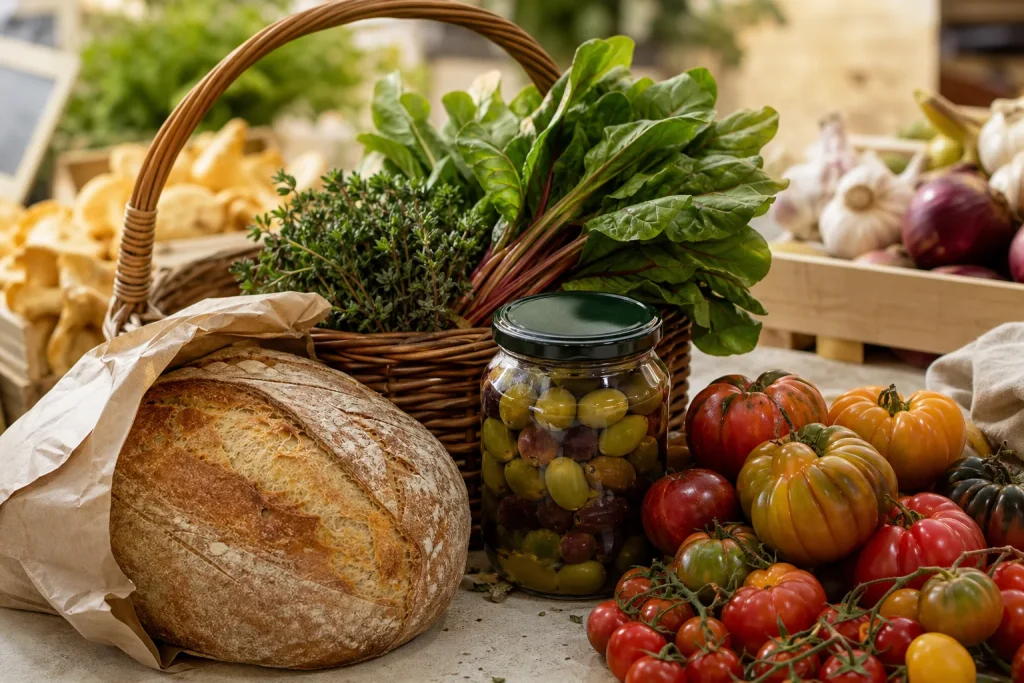
You pause beside a stall of late-summer tomatoes, then notice a jar of olives, a bunch of herbs and a loaf wrapped in paper. The foods do not need to be rare to prompt a useful question: what might people make with them, and what has travelled to bring them together?
A market is less a portrait of a region than a working place where growers, traders, cooks and shoppers meet. To read it well, follow the practical links between foods and ask vendors about their own goods. That approach offers more than a tidy story about geography: it can reveal how a particular product is sold, prepared and fitted into an ordinary meal.
What is ready to eat now?
Notice which produce appears at several stalls, then ask whether it is harvested locally or brought in from elsewhere. Repeated displays may reflect what is in season, but they may also reflect what vendors can source or customers expect to buy. A place name on a sign is a useful starting point, not a complete account of the supply chain.
If a vegetable is unfamiliar, ask the seller how they would prepare that particular one. Their answer may point to a local habit, a family preference or simply the vendor’s own method; asking which keeps the distinction clear. You can also compare the answer with the condition of the food: tender leaves may suit quick cooking, while firmer produce may hold up in a longer dish.
What does a product’s route tell you?
Rather than infer a market’s contents from whether it is near a coast, hills or farmland, look for information attached to the goods. Check signs for a named grower or origin, ask whether an item is produced nearby, and notice when a seller distinguishes between their own produce and goods sourced through a wholesaler. If no one knows or has time to explain, leave the origin open rather than filling the gap with a regional stereotype.
Trade is part of the picture too. A market can bring together foods from different places because shoppers want them, because local production is seasonal, or because a trader specialises in particular goods. The label and the seller’s account can help distinguish those possibilities, though neither necessarily explains the whole journey from producer to stall.
Which foods are made to keep?
Dried beans, pickled vegetables, jams, smoked fish and jars of tomato passata show different ways of making food last or readying it for later use. Ask how a particular product is prepared and what people serve with it. The answer may concern a traditional method, a producer’s current recipe or a practical suggestion for using what is on the shelf.
Check the jar or packet if you want to know who made it and where. If the label names a nearby producer, you can describe it as locally made; if it names a distributor or gives no clear origin, do not assume the ingredients or preparation are local. A market can hold handmade goods and larger-trade products side by side, much as a kitchen drawer holds tools bought for different jobs.
How do ordinary staples connect the foods?
Bread, flour, rice, pulses, onions and cooking oil can tell you how a meal is assembled more clearly than a display of unusual specialities. Look at what a vendor recommends alongside a seasonal ingredient. Ask which bread suits a particular cheese, or what the seller would serve with a dried bean.
Keep the answer attached to its source: “this seller recommends” is more precise than “people here always eat”. If the stall is too busy for a conversation, read the product label, observe how the goods are grouped, or move on. A display may be arranged for convenience rather than to express a customary pairing.
What can a pairing explain?
Pairings are useful when they lead to a question, not when they are treated as proof of a regional rule. Ask whether a suggested combination is common, a seasonal choice or simply the vendor’s favourite way to serve the food. The distinction matters, especially when the market serves residents and visitors with different tastes.
Say you find ripe figs at one stall and fresh goat’s cheese at another. You ask the cheese seller how they would serve it, and they suggest cheese on bread with figs alongside. If you buy those three items and try the suggested arrangement, you can observe how the fruit’s sweetness meets the cheese’s savoury tang; what you cannot conclude from that meal alone is that the pairing represents the whole region.
What should you check before choosing?
A compact set of questions helps turn impressions into decisions. Each answer can guide your next action without asking a single stall to speak for an entire place.
- Origin: Check the sign or ask where the item comes from. If it names a nearby producer, treat that as evidence of stated local origin; if the source is unclear, leave the origin unclaimed or ask another vendor.
- Season: Ask whether the produce is in season locally. If the seller confirms a local harvest, consider it a seasonal choice; if it is brought from elsewhere or the seller is unsure, do not use its presence to infer the local growing calendar.
- Preparation: Ask how the vendor cooks or serves the item. If they offer a specific method, use it as a practical suggestion; if they have no answer or are busy, choose a familiar preparation or keep browsing.
- Preservation: Read the label or ask how a jarred, dried or smoked food was made. If the method and maker are stated, describe only those details; if they are not, avoid assigning the product to a local tradition.
- Pairing: Ask what the vendor would put beside the food. If the suggestion suits something already in your basket, try the combination; if it does not fit your meal or taste, choose another accompaniment.
- Use at home: Check whether you know how you will prepare the item and what you will serve it with. If you have a workable meal in mind, buy what you expect to use; if not, ask for a simple preparation or leave it for another visit.
- Conversation: Notice whether the stallholder has time to talk. If they are free, ask one direct question; if they are serving a queue, step aside and rely on the sign or return later.
How can a basket stay honest?
Imagine you have bought a loaf, a jar of olives and a bunch of greens. The olive label names a producer in a nearby town, while the greens stall gives no origin and the baker says the loaf is made on site. You ask the olive seller what they serve with the olives and hear that bread is one option. At home, you warm the greens, set out the olives and slice the loaf; the resulting meal shows that the three foods work together, while the available information supports only the stated origin of the olives and the bakery’s account of its bread.
That is a useful basket without a grand claim attached. It gives you a meal, a few answers from the people selling the food and a clear sense of what remains unknown. If you return, those unanswered questions—about a grower, a preparation or a staple—are more useful than a ready-made story about what an entire region eats.
Along the same table
A Shared Bottle, Several Ways to Serve It
At one imagined supper, a host keeps wine service flexible: guests can choose when to pour,…
From Curd to Texture: The Choices Behind a Cheese
A cheese’s moisture and texture begin to take shape before the curds reach the mould. Learn…